
Not of the season. It is the first time this tree has bloomed! Ever. It has been pruned at the wrong times in the past. Everything has its season for blooming and pruning. It would get scraggly and in the way in the summer so somebody would snip at it. Finally, we got it right! 
That's the top of the neighbor's house. The daphne (next post) is to the left of this tree.
Showing posts with label plants. Show all posts
Showing posts with label plants. Show all posts
March 10, 2010
First Bloom

Spring Snow
 This daphne blooms every winter. Sun or snow. The olive tree in front of it is not doing well.
 This one azalea bloom is a little early.
September 16, 2008
Lotus Seeds

This is a lotus seed pod at Jindai Botanical Gardens. Photographed on the 10th. It reminds me of a picture book that I want to (buy and) read. It is called The Journey of the Third Seed by Jane Scoggins Bauld, Eakin Press. Three lotus seeds were lost at sea in a typhoon over a thousand years ago, but one ended up in the Japanese Gardens in Austin, Texas. The author knew Mr. Taniguchi, the man who planned and built the Japanese gardens. He planted the lotus there. I went to university there. I remember going to the garden but I didn't see the lotus. Perhaps someday...


A dried pod.

Lotus Leaves


June 07, 2007
Natural Pesticide


It's a baby praying mantis. It will get big and green as the summer goes on. It will shed its skin. There's already a lot for it to eat. I'm glad we have this natural pesticide! It is the third generation of praying mantis that I know of. (I've only been in charge of the garden for three years since Jiji passed away.) Click on the label below or do a blog search to see posts about praying mantis and other bugs and insects.
June 03, 2007
What It Is

A picture of this plant with a dark purple blossom was posted on May 18. Turns out, it's eggplant! The eggplant is small now and will be small when it's ready to be picked. The eggplant grown here are small.
Check the post for January 2, 2007 for more about eggplant.
May 18, 2007
What Will This Be?


May 16, 2007
Huki or Fuki

There are fields behind our house. The farmer who grows vegetables there told Baba she could have the huki that was growing along the fence. Little Brother went into the field and cut it for her. He handed it to her over the fence.

Huki is called fuki in English. There is no /f/ sound in Japanese (actually the sound is between an /h/ and an /f/). I think the plant is in the coltsfoot or Japanese Butterbur family.
May 09, 2007
Bobbing Discs


There were several of them.


A farmer tied CDs to plastic and bamboo poles. The CDs bob anyway but especially in a breeze.
May 04, 2007
Neighborhood Color Adventure

A green "Dr. Seuss" tree. Red Robin shrub.


A gray garden gate.

Multi-colored azaleas along the street.
May 02, 2007

April 29, 2007


April 28, 2007
Even the Onions Bow

Maybe this is a haiku moment.
Patricia Donegan points out in in her book, Haiku, that Basho, a Japanese haiku master, said, "Follow nature and return to nature" and "Learn about the pine from the pine and learn about the bamboo from the bamboo." And onions from onions, too, I guess.
April 22, 2007
Wisteria

Wisteria needs support, too. This one hasn't begun to bloom.

This is what the blooms look like before they open. These will be purple.

Here's one that is getting a lot of attention. It was beautiful. It's not a very good picture, though. The camera was focusing on the man in front.

Some wisteria are white.
Jindai Botanical Gardens
Wisteria Lane

Here is a purple wisteria blossom in full bloom.

Maybe in a week or so this wisteria will all be in bloom.


This is the base of the vine.
February 20, 2007
Daphne

Our daphne shrub hasn't bloomed yet. It has been in a shady part of the garden for decades. Great-grandfather planted it long ago. As I walk down the street, I know other daphne shrubs are blooming somewhere. The fragrance is strong. It is very distinctive from the ume that is also blooming now. It seems both are blooming late this year.

On the way to the shops, I found a daphne shrub that is starting to bloom. This one was in a pot!
October 21, 2006
Taro and Potatoes
 I've posted pictures of taro. These are yatsugashira. Their stems are red and their leaves are different.
 I have waited to get a picture of them during harvest. Here they are as they are harvested. They are dug up. The stalks are cut. The taro is then placed in a tub and made ready for sale.
 Here they are at a vegetable stand. These are rather clean. I have seen them in plastic bags in stores with dirt still on them. I will try to get a picture of them cooked and prepared to eat. They are not our favorite. They are sticky and slimy. We rarely eat them, but Baba and Aunt do. They share.
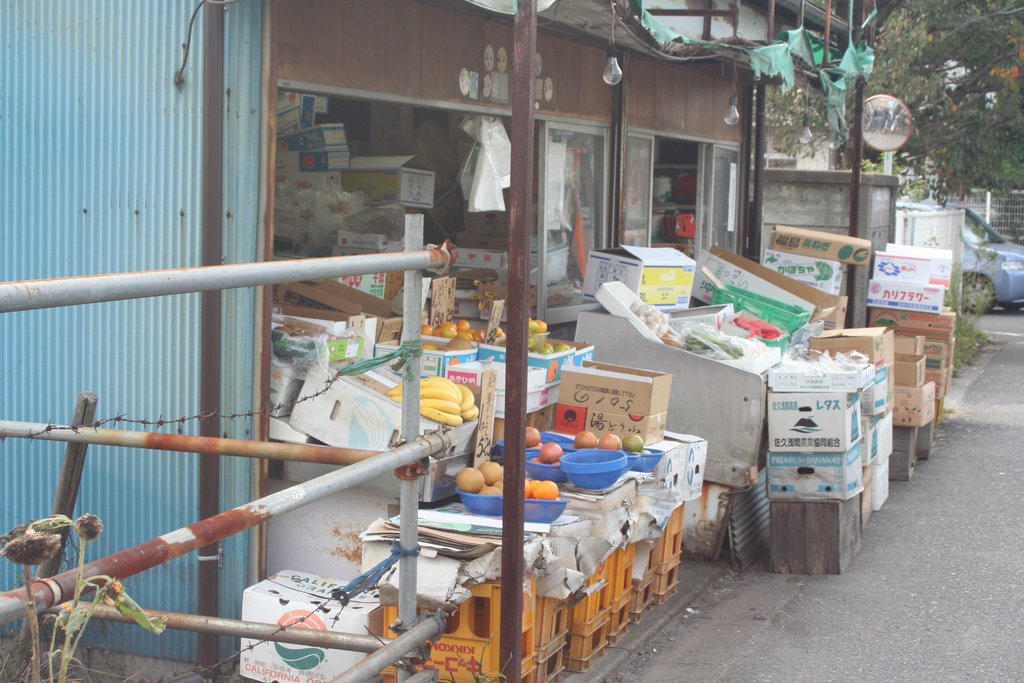 This is the vegetable stand where I found the box of clean taro. It is near a small station.
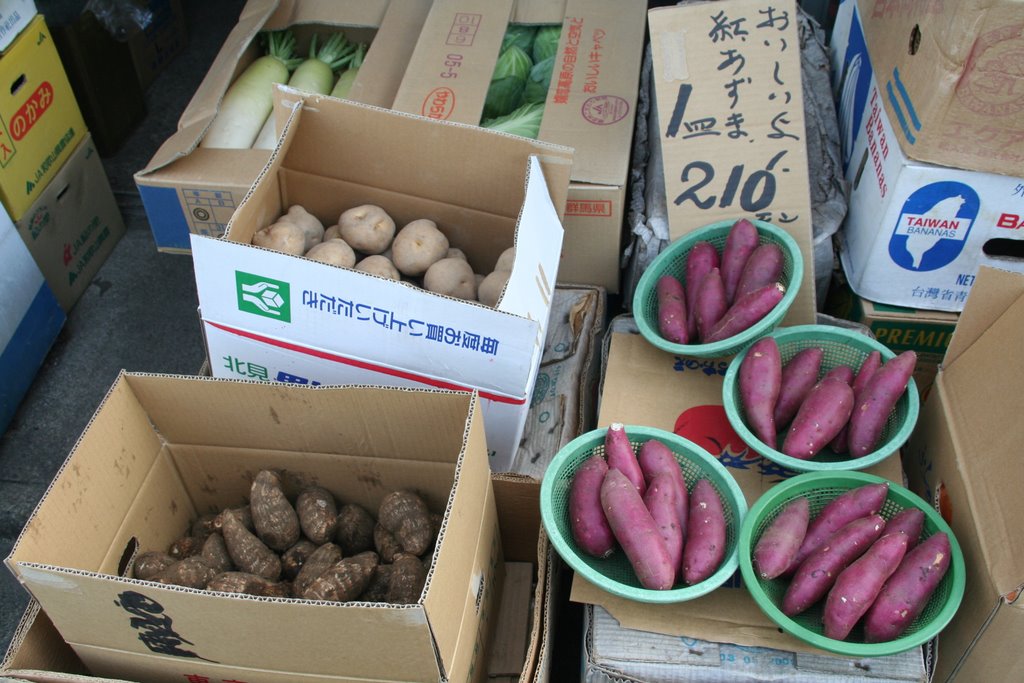 Here is the box of taro along with other vegetables and potatoes. Do you see the box of big Japanese radishes or daikon?
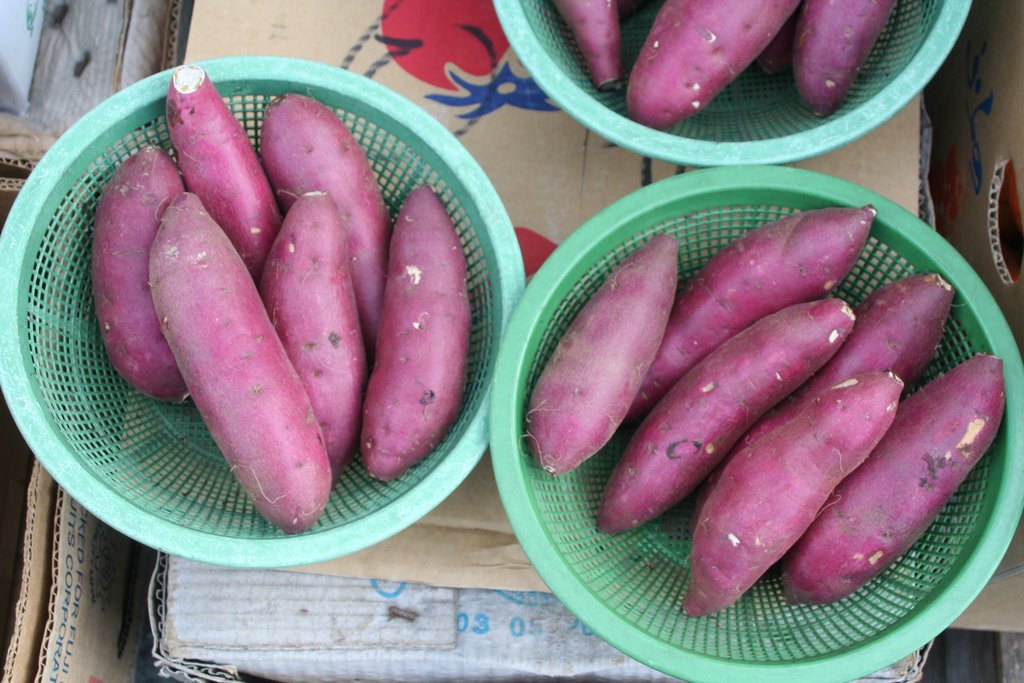 These are satsumaimo or sweet potatoes. They are not orange inside like American sweet potatoes. We eat a lot of these through the winter. I will show you later.
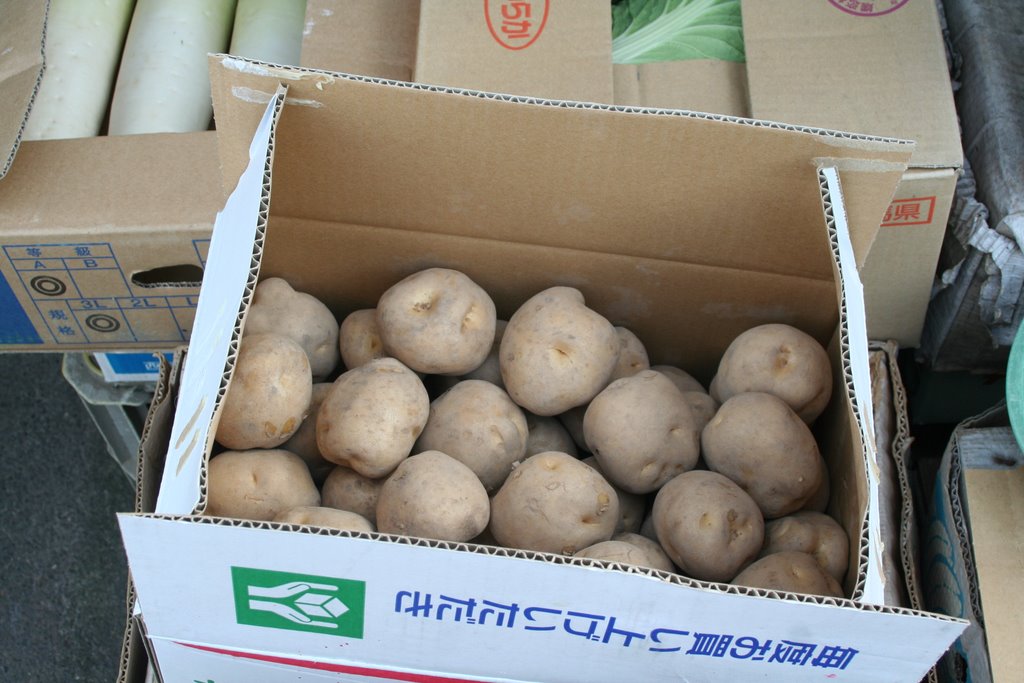 These are regular potatoes or jagaimo. They are smaller and have thinner skins than Idaho potatoes.
Subscribe to:
Posts (Atom)


