 Entrance to a large tea room.
 An entrance to a small tea room on the other side of the larger entrance. That is a small wooden door. One must crawl through to enter.

A window screen.
Showing posts with label June in Japan. Show all posts
Showing posts with label June in Japan. Show all posts
June 24, 2010
Tea House

June 23, 2010


June 17, 2010


June 16, 2010

June 30, 2006
Summer is Here

There are many things throughout the year that signal the change of seasons here. For summer, putting up bamboo or straw screens is a sure sign that the hot days of summer have arrived. On the way to the station today I noticed the fruit shop had put up their screens. Yesterday was very sunny and hot. Today, it's overcast but still hot.
It's important for fruit shops and vegetable shops to keep the sun from spoiling their produce, but you see these screens all over the place. Some shops put them up to block the sun from fading their wares. Home dwellers have them up to reduce the temperature in the house. It does help.
Department Store Cart

I went to a department store today. As I left, I noticed they had these carts. I usually go out another door so I had never seen them before. Maybe they were new, I'm not sure. These are to carry all your bags and packages of things you have already bought. I guess. I can't imagine that they are shopping carts for you to load up and take to the register. How much stuff would you buy in one visit at a department store? Besides, many clerks are around to help carry things to the register for you.
Mothers on Bikes

I took this picture the other day. This is a very common sight. Mothers ride with their children in seats on the back of their bicycles. They sometimes carry another child in the front, too. The woman on the left has a child in front as well. With all her seats filled, she is carrying a bag on her handlebars and on her back. Younger children are usually put in a seat in the front of the bicycle. I have even seen mothers ride bicycles with their young children strapped on their backs in baby carriers.
I couldn't juggle children and groceries on a bike. Big Sister and Little Brother rode in a stroller until they were old enough to walk to the store with me. It was hard, too. We had to go to the store every day because the stroller couldn't carry many bags of groceries.
Note that these mothers are riding on the sidewalk. I was walking along behind them on my way to the grocery store. My children were still at school. I had my shopping cart.
June 29, 2006

June 28, 2006
Samples of Passnet Cards
These cards are used to make the benches that were shown in the May 19th post. See the post for pictures of the benches. The cards are made of lightweight plastic. They are flexible. Train passengers can buy these cards, so they don't have to stand in line at the ticket machine each time they need to ride the train. These are for the Keio train line. They are sold in denominations of 100 to 5000 yen and they come, as you can see, with many different designs.
This is the basic design. It shows different kinds of trains.
Some cards are Disney,
some are cute animals,
and some are seasonal.
In the May 19th post, I mentioned that the turnstile kept the cards after they were used up. That was incorrect. (I have edited the post.) The turnstile only keeps tickets that are bought daily for specific trips. Used up passnet cards are turned in at the station either by handing them to a train station employee or by putting them in a box.
Big Sister has a few points still on some of these cards. At first, she wanted to start a collection of them but has decided to turn them in at the station. Here is the box at our station.
June 27, 2006
On the Street: Stop Signs 2
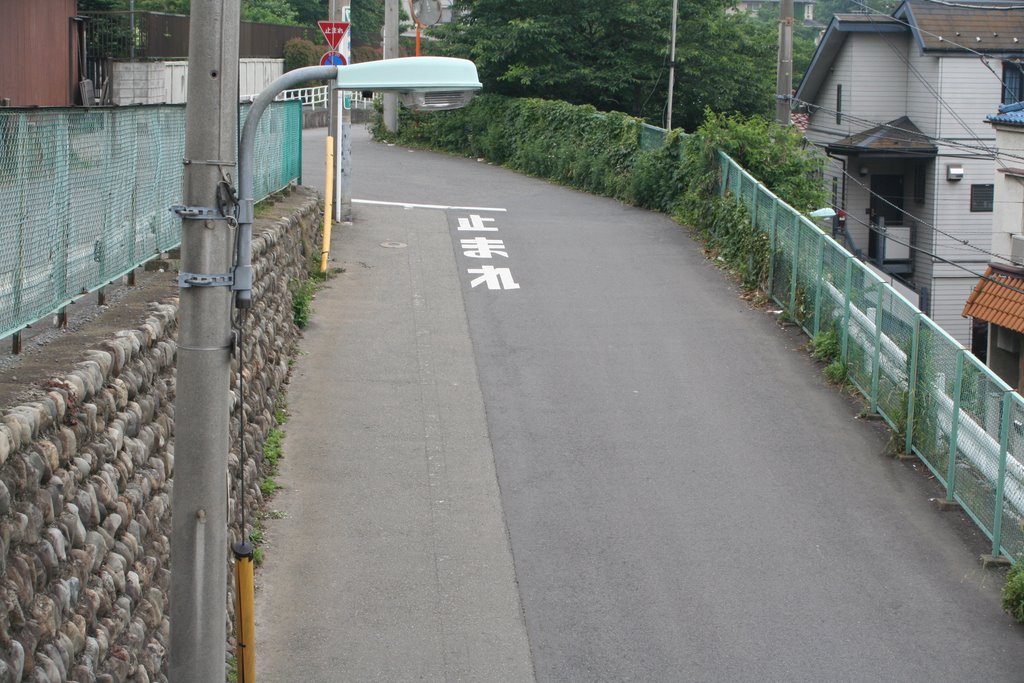
Some stop signs are painted on the street.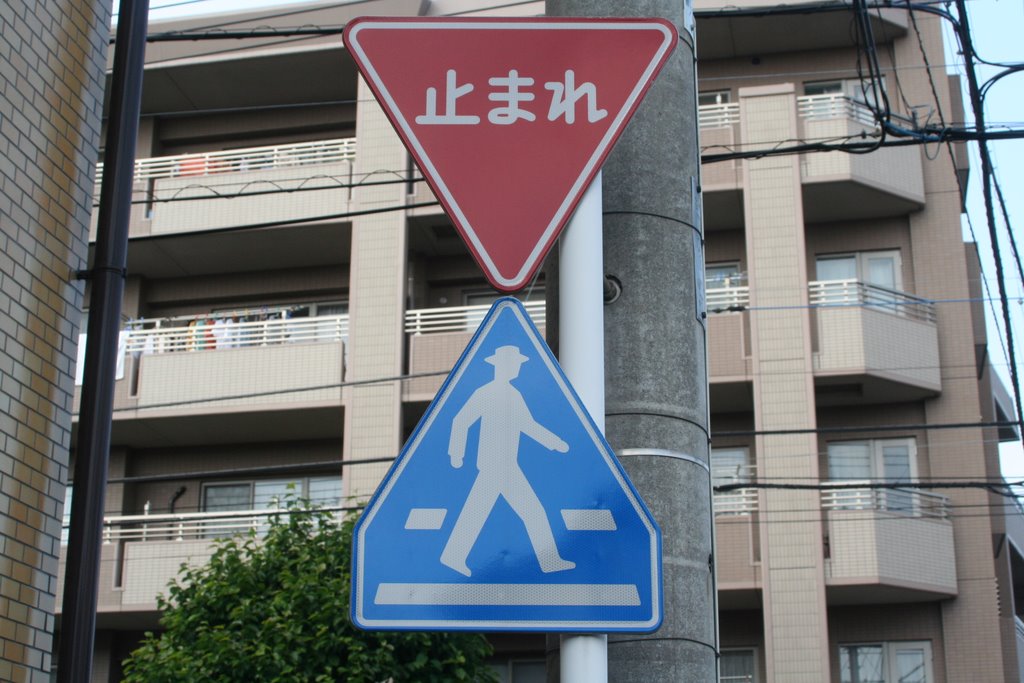
Some stand on the sidewalk.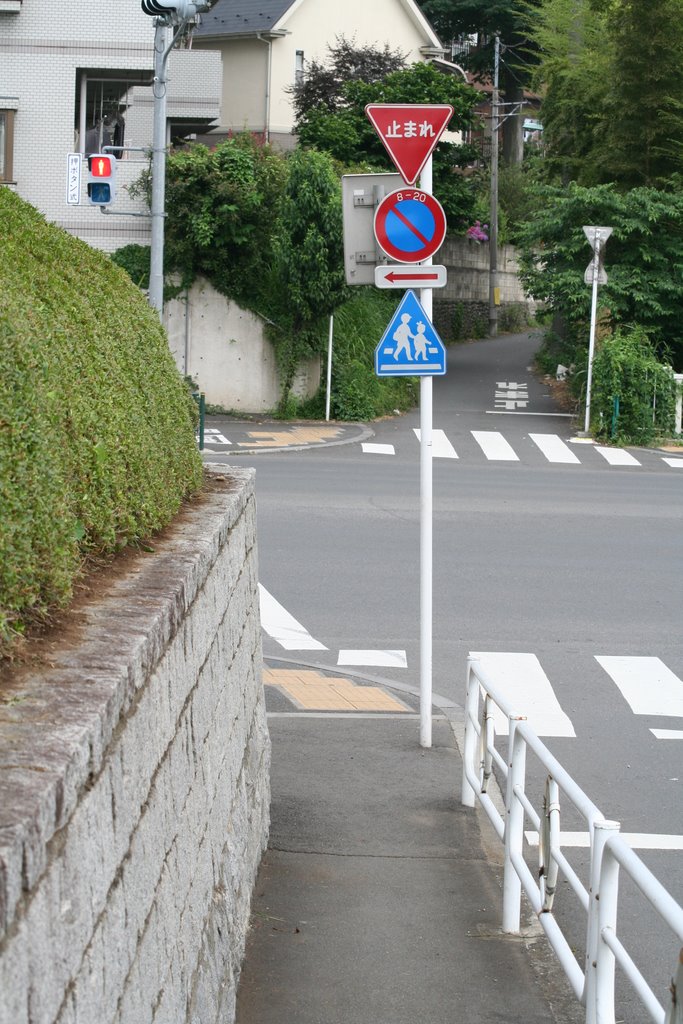
Some share space with other information.
The upside down triangle is the stop sign. Tomare is written on it. Notice the first symbol is not hiragana. It is kanji, the symbols adopted from the Chinese language.
What do you think the blue signs mean? One has a man walking between two white lines. The other has two children.
Under the round sign, there is an arrow. Can you figure out what that means?
June 26, 2006
On the Street: Stop Signs
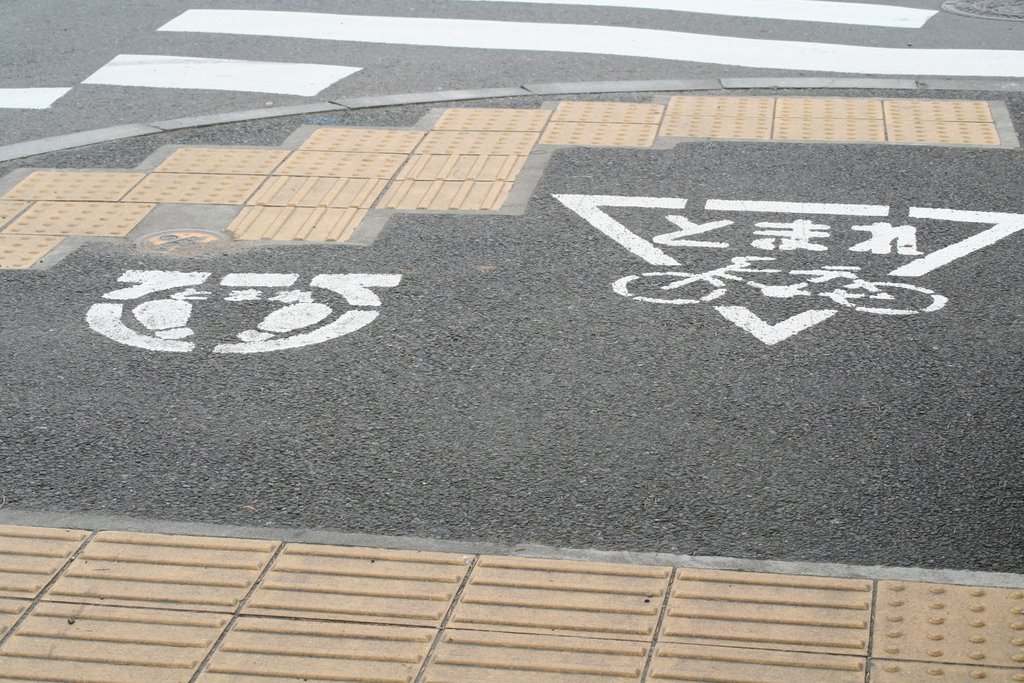
Sometimes stop signs are printed on the sidewalk.
This sign tells pedestrians to stop. It can be read by all ages. First, the graphics tell what to do. In addition, the Japanese word tomare is printed in hiragana above the footprints. Even young children can read words written in hiragana.
This one tells bike riders to stop. Tomare is written in hiragana above the bicycle.
In my area, these signs are sometimes found on smaller cross streets where there is no traffic light. Sometimes there is a sign painted on the street telling motorists to stop.
People ride their bicycles on the sidewalks here. When I first came to Japan I was given some really good advice. I was told to walk in a straight line and not to make any sudden moves. Also, to look back when I change "lanes" on the sidewalk. Bike riders see you from a distance. They will pass you if you're in their way. If you jump out of your "lane", they will hit you. Bikers are supposed to ding their bells as they come up behind you, but often they don't.
Note that there are yellow raised lines on this street. Not all streets have them. They are for blind people to use to walk down the street. Note, too, that the yellow strips closest to the crosswalk (the white stripes in the street) have raised dots. They tell the blind person to stop.
June 25, 2006
At the Station 2: Lines for the Blind

These are the stairs leading to the train platform. Note the red and white markers along the side. They are raised strips for people who are blind, but they also reflect light in case the lights go out in the station. The yellow strip at the bottom of the stairs is for blind people to follow to find the stairs. They can also follow them to find the exits when they are coming down the stairs. There are raised stripes on it so they can feel where to go.
Blind people can follow the yellow strip up the stairs. There are three squares of raised dots that signal to them to stop. There is a yellow strip along the platform of raised dots. It is a signal to stop and not go beyond the line.
The train will stop and the door will open at the squares of raised dots. That is where a blind person will most likely be standing to catch the train.
June 24, 2006
At the Train Station
What do you think these spikes are for? On the train platform, they are everywhere up above.
On the signs,
on the camera,
on the beams and outside walls of the building,
and even on the clock.
They were put there to prevent pigeons and other birds from building nests up above. Because of the spikes, the birds can't even sit above the platforms. All the train platforms on my line are open to the outside, but not all of them have these spikes. Surely, birds know to stay away from these places. At least, I hope so.
June 23, 2006
Bugs, Bugs Everywhere


It's only the beginning. Of summer and BUGS. There are all kinds of bugs here and they all have names. I mean names that people know. In Japanese. I bought a book of bugs and there were over 15 ladybugs, all with different names in Japanese. Bugs and plants also have names in Latin and that is the key to figuring out if they are located in other parts of the world, too. We all use those names to identify them. Unfortunately, the book I bought doesn't have those names. That was an oversight on my part. There was one book at the store that included them. I'll have to either buy it or look them up on the internet. If you know any of them, let me know.
Have you ever seen anything like these? The first two pictures are of the same bug. I took two pictures to show you how big it was. It was sitting on a raspberry leaf.
Later today, I was in the garden and felt something on my arm. I thought it was a mosquito and was about to swat it. I looked down and it was a teeny, tiny praying mantis jumping around on my arm. I let it jump onto a plant. I'm glad I looked down! He will eat uninvited and undesirable bugs in our garden.
On our way out the other evening, Little Brother and Big Sister found this on the side of the house. They told me that it was one of the most expensive native beetles. This is the season of catching or buying beetles and other bugs. We decided to leave it alone. Little Brother had just bought a male and female Malaysian beetle earlier that day. The male looks a lot like this one. We're going to have even more bugs as the summer months continue.
June 22, 2006
Close to Home

I came in from the grocery store and went around to the back of the house to check on the catepillars. I saw this butterfly, a swallowtail, fluttering around on Aunt's flower pots. The flowers didn't look very tasty. Even with all the rain they had drooped. All that to say, I didn't think he would stay there very long.
So I ran into the house, actually it was more like I walked fast, and got the camera. Unfortunately the wrong lens was on the camera so I couldn't get a close-up. I took a few pictures anyway. Can you see the blue at the bottom of his wings?
This butterfly was jerking a lot and to me it looked like he was drying his wings. Could he have been one of our caterpillars? All the caterpillars but one are gone. Wonder how long that whole process takes. I remember my Dad used to say, "Look it up!"
Here are some of the things I bought at the grocery store:

This is goya, a bitter vegetable from Okinanwa, Japan. It's supposed to be very good for your health.

Notice how small the green peppers and cucumbers are here. The peppers (above the dollar bill) have very thin flesh. As I recall, the ones in the States have very thick.
June 21, 2006
Closet Dehumidifier

These are a dehumidifiers that we put in closets here. The dehumidifier on the left is an old one. It has a plastic blue grate I guess to protect the thin paper top. Its bottom section is now full of water.
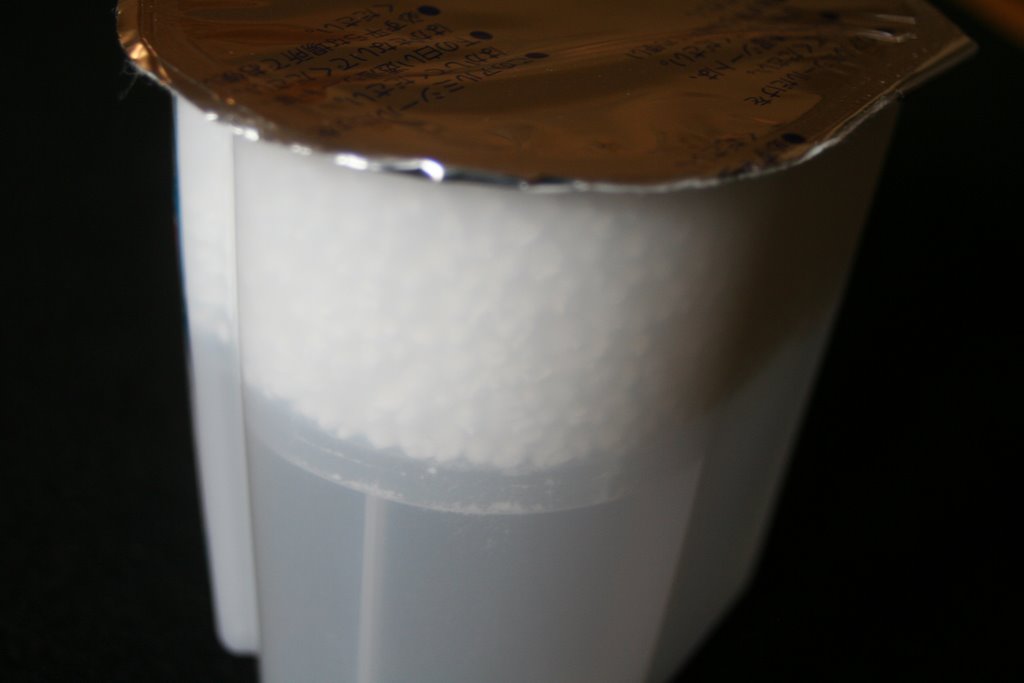
The one on the right is new. I will pull off the silvery cover to expose the paper on top. Then I'll put it in a clothes closet. It will absorb the water from the air in the closet. It is divided into two sections by a plastic shelf that has slits like a seive. The top is filled with Na and Ca granules. (Do you know what that is? No? Look it up!) The bottom is empty. As water is absorbed, the granules dissolve and the water goes into the bottom section.
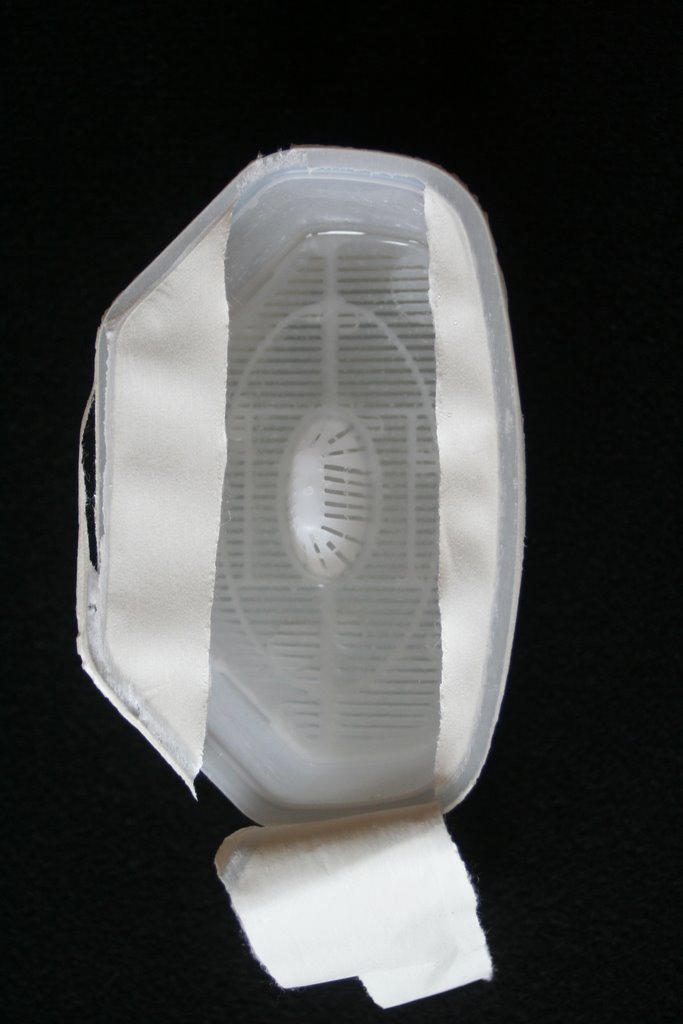
Here is the old one after I've poured out the water and cleaned out the granules. Actually, they had become a hardened mass. We have to wash some of our garbage here and put it into the appropriate garbage bag. Plastic goes in one and paper in another. I put most of this in the bag for questionable, broken and messy items.
June 20, 2006
Views from the Car
Today we went across town (Tokyo, that is) to a doctor's appointment. Here, people would say "we went to the hospital". I remember that used to sound shocking and serious, but it only means "we went to the doctor". Doctors treat their patients at hopsitals or small clinics here. So when you "go to the doctor" you go to a hospital or small clinic.
Here are some scenes from the car on the way home. By the way, it's not so easy taking pictures from the car! It requires keeping the window down and that's not so comfortable in a big, dirty city. It was fun, though.
Waiting in traffic.
The NTT (Nippon Telephone & Telegraph) building in Shinjuku is off in the distance. Nippon means Japan.
We were parked at a traffic light under the highway. Notice the cars parked along the side! There's a familiar sign in the background. You can barely see it. It's Shell Oil.
Another pizza delivery motorcycle. Notice Domino's motorcycles have a rain shield/roof.
Subscribe to:
Posts (Atom)


